Digital EnterpriseAug 2021 to Jul 20254 min read
Digital Enterprise, the first system I built for other people
I co-founded a student-run nonprofit that taught high schoolers to start online businesses, and grew it to 400 students across 20+ high schools.
- Role
- Co-Founder, Director & Front-End Developer
- Period
- Aug 2021 to Jul 2025
- Team
- A two person board and student executives in every chapter
- Stack
- Webflow CMS, Notion, Airtable, Zapier, Google Workspace, AwardForce
- AI in the loop
- None in 2022. The 2026 redesign was built in Claude Code.
01 · Why
A club that came out of my first business plan
Digital Enterprise started because of Swire. I had just written my first business plan for the Diamond Challenge and learned more from building a real venture than from any class. The experience, as I wrote at the time, prompted me "to start a club and share my newly-obtained knowledge."
The appetite was there. In one survey of Vietnamese aged 15 to 35, 25.7% wanted to work for themselves, third highest in Southeast Asia. School business programs still stopped at theory.
Everything I built in high school came back to one idea, giving young people access to real work and real opportunity. Digital Enterprise was the version for founders. Teach students to build an online business, then make them actually run one.
I co-founded it and led it as director. I set up how the organization ran, wrote the curriculum and the competition rules, built the website and registration platform, and brought in the partners and sponsors that paid for it.
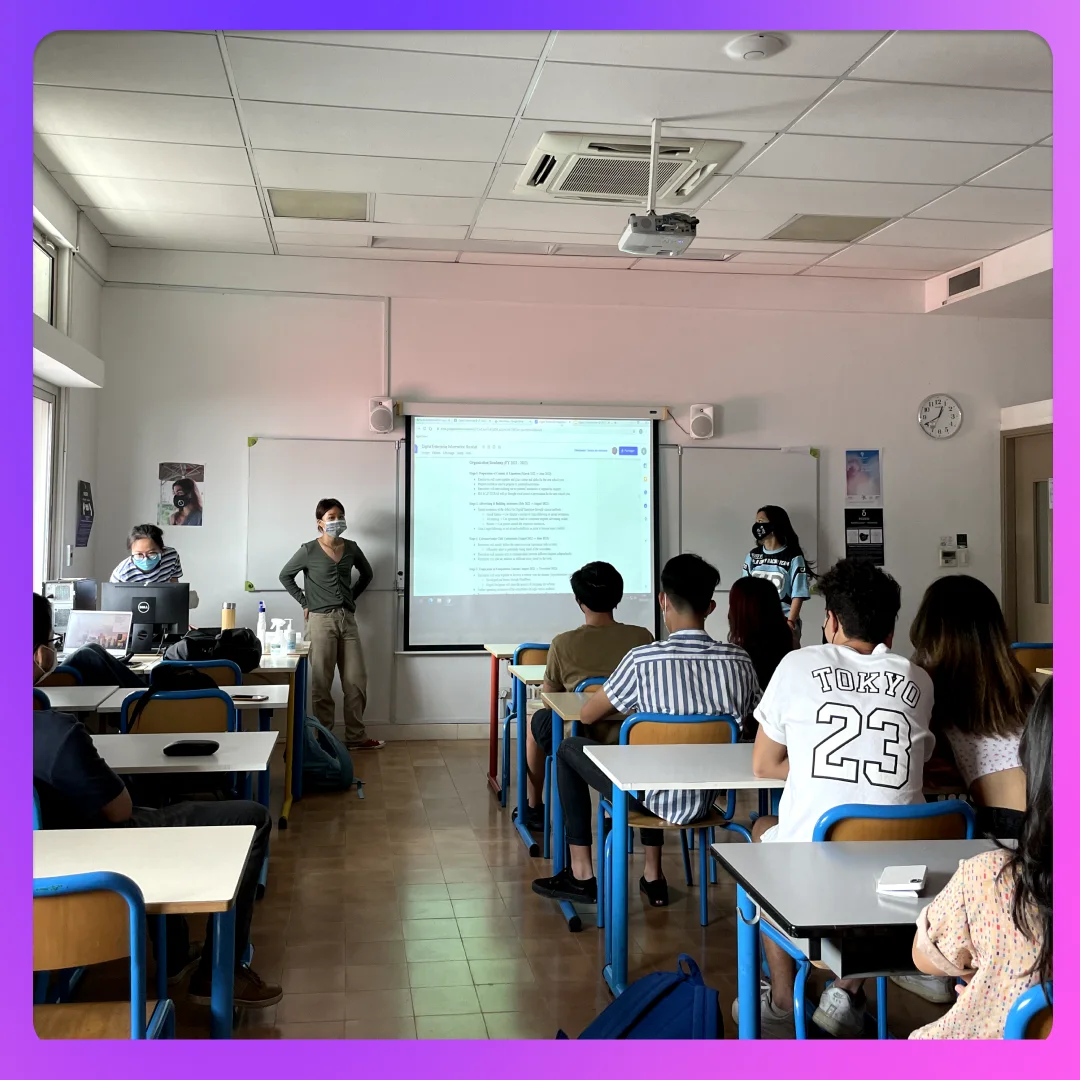
A weekly chapter session working through the curriculum.
02 · Structure
Writing the system before recruiting the people
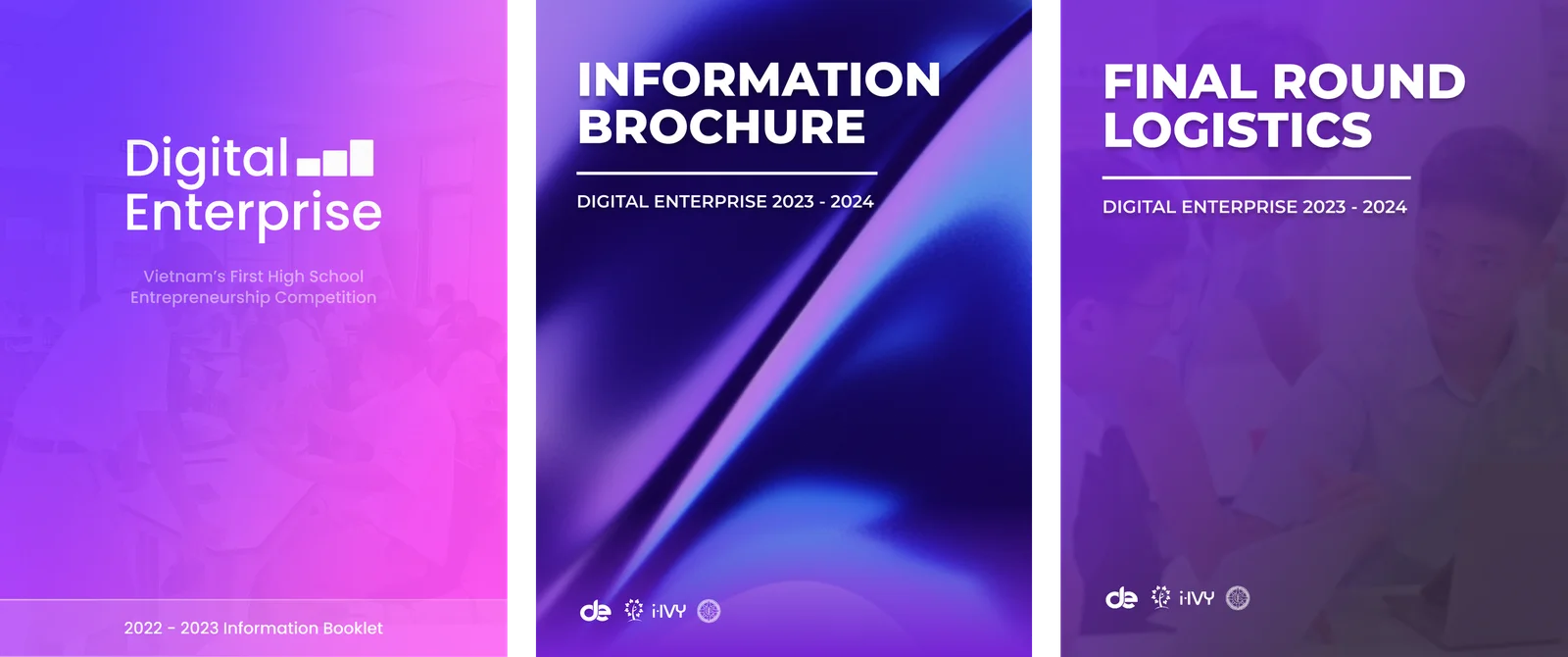
A student club usually depends on one motivated founder. I wanted a chapter at any school to run the same way without me in the room. So before we grew, I wrote the information booklet that set down the roadmap, the roles, a chapter code of conduct, the competition rules, the budget and the marketing plan.
The core was a 16 week club curriculum. Teams start with the types of e-commerce and the parts of a business plan, then brainstorm, form groups of three to six, and survey their own school for demand. From there they work through TAM SAM SOM market sizing, a SWOT analysis, a business model, a financial model in Excel and a growth plan. By week 16 each team has a plan it can enter into the competition.
We trialled the format at two schools from March to May 2022, then opened it up. Every chapter had a student president and vice president, schools without a full chapter had marketing representatives, and a city representative kept each city in step. By June 2022 that covered 22 schools in Ho Chi Minh City and Hanoi, plus a chapter at Seoul Foreign School in Korea.
03 · Competition
A competition judged on what teams built, not what they pitched
Other student competitions took a theoretical approach. I designed ours so teams had to follow through. They funded their own start-up costs, sold a real product or service, and gave at least 10% of profits to a charity of their choice.
It ran in four rounds, a business plan, a marketing plan of up to 15 slides, a five minute pitch video, and a live final. The prize pool was $1,800, with $1,000 for first place.
We took submissions and ran judging in AwardForce, which saved the team time and kept every round on a fixed timeline from the day submissions opened, June 27, 2022.
The 2023 final ran on May 14 at North London Collegiate School in Ho Chi Minh City, in a hybrid format so teams outside the city could join remotely. Six teams pitched to three founders and CEOs of Vietnamese companies, who scored each team from 1 to 10 on feasibility, sustainability and growth, impact, marketing and a wow factor.
Between rounds we ran webinars to help teams, including one with a Dartmouth Tuck entrepreneurship professor.
04 · Platform
A Webflow front door with Notion and Airtable behind it
I built digitalenterprise.vn and its registration platform on Webflow CMS. It was the front door for everything. Students joined a chapter or registered a team, schools applied to start a chapter, partners found a way in, and a newsletter carried announcements and interviews.
Behind the site I set up the tools the team ran on. Notion and Airtable held projects and records, Zapier moved data between them, and Google Workspace carried email and files for every chapter. This was the first time I built a system for other people to operate.
By April 2023 the site reported 300+ members, $12,000 raised, 1.7K+ social followers and 20+ institutions.
05 · Partners
Getting a team's costs down to about $40
Starting an online business costs money most high schoolers do not have. So I went to the tools teams needed and asked for access. Digital Enterprise became a Notion for Startups partner, which gave each team six months of free Notion Plus with Notion AI, about $6,000 in benefits. We also partnered with Webflow. Together the partnerships cut a team's startup costs by 85%, to about $40.
Corporate sponsorship paid for the clubs, events and competitions, more than $20,000 over my time running it. i-IVY Education and Embassy Education sponsored the competition, and North London Collegiate School hosted the final.
| When | Reach | Money raised |
|---|---|---|
| 2022 | 14 institutions in 6 countries, 250+ members, 30 organizers | n/a |
| 2022 to 2023 season | 20 chapters, 300+ participants | $12,000+ |
| Latest CV | 400 students across 20+ high schools | $20,000+ |
06 · What carried forward
It kept running after I handed it over
I handed Digital Enterprise to the next class of student leaders, and they still run the competition and the site under a new design.
The habit I kept is writing the system down so it runs without me. In 2022 that was a booklet. Today it is an AGENTS.md brief at every level of my work, read by people and by the agents I build with.
- students
- 400
- across chapters and the competition
- high schools
- 20+
- in Ho Chi Minh City, Hanoi and Seoul
- corporate sponsorship
- $20,000+
- for clubs, events and competitions
- lower startup costs
- 85%
- to about $40 a team, through Notion and Webflow
Reimagined in 2026
The platform we should have run it on
In 2022 Digital Enterprise lived across Webflow, Notion, Airtable, AwardForce and Google Workspace. In 2026 I redesigned it as one product, built in Claude Code, to show how I would run it now. Everything below is placeholder content.
The landing page leads with what is happening this week, here round two judging.
The roster that used to live in a booklet table becomes a directory of every school and chapter, city by city.
Judging that we ran in AwardForce becomes a live scoreboard. Scores land as judges submit them and teams re-rank.
And the 16 week curriculum becomes a workspace a team works through, week by week.
Archive